Labour, Choices, and Intention: Al & Art through Two Texts independent
02/Nov/24 at 8:00 PM to 02/Nov/24 at 10:00 PM
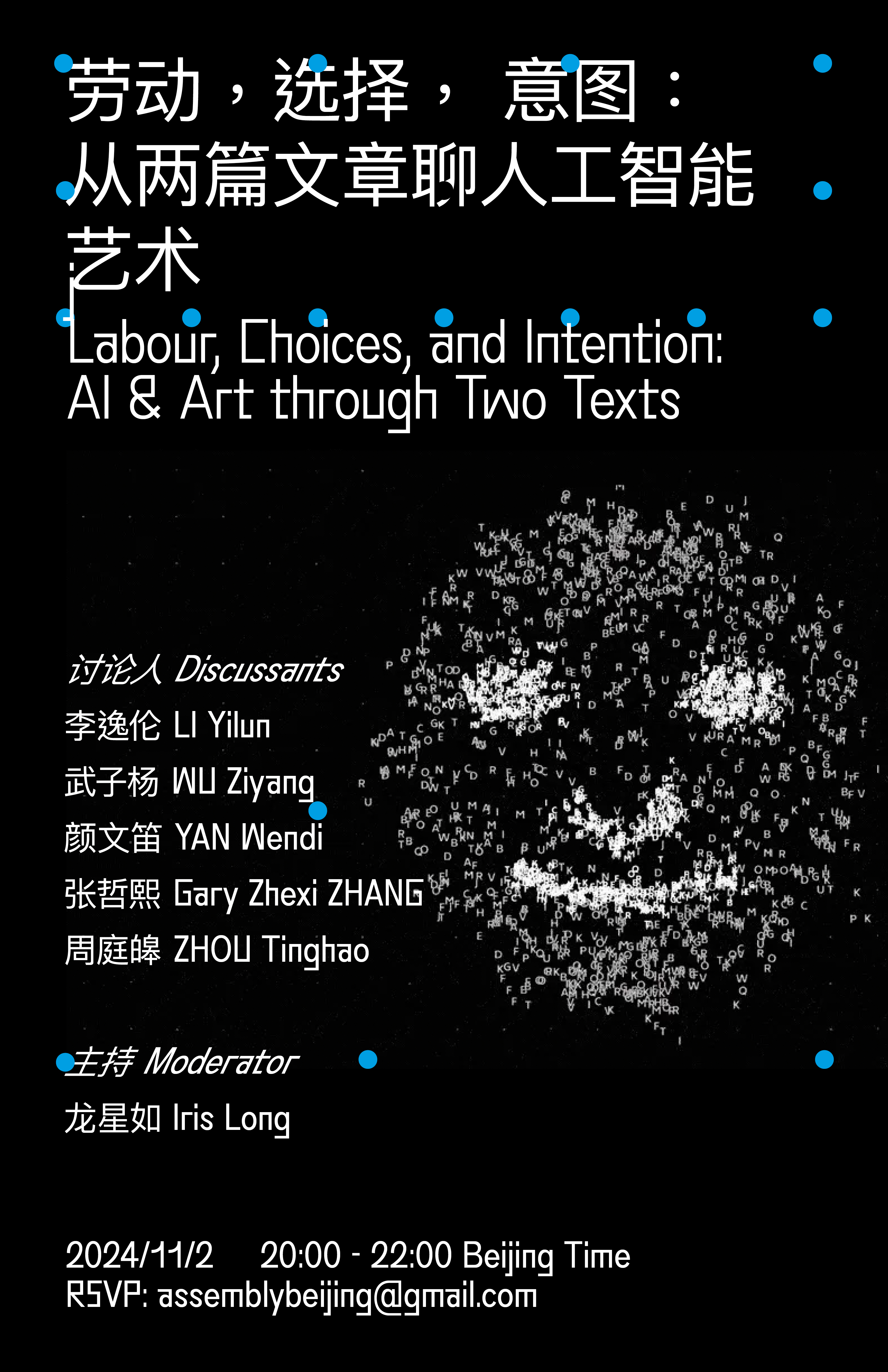
In 2023, science Fiction writer Ted Chiang Contributed an essay to The New Yorker, likening large language models to "a blurry JPEG File on the internet." alluding to a form of lossy compression) . Subsequently, The Atlantic editor Matteo Wong, in a separate article, addressed the distinctions between the brain's language network and the neural mechanisms governing other functions (such as music and programming) to elucidate why Al programs excel at "producing grammatically Flawless nonsense".
A year later, the two authors revisited the topic of artificial intelligence on the same media platforms, yet this time their perspectives stood in stark opposition. In his essay "Why A.I. Isn't Going to Make Art," Chiang sought to expose the limitations of Al in the realm of artistic creation. Much like his earlier "blurryJPEG File" analogy, Chang continues to deftly translate complex technical concepts into approachable metaphors, though occasionally at the expense of precision. Drawing upon Road Dahl's idea of "The Great Automatic Grammatizator," he uses this analogy to characterise Al-driven model generation. In this piece, Chiang argues that the essence of defining "art" lies not in the medium itself (or the skilful use thereof) but in the depth of labour the medium enables and the creator's intention behind.
These two elements, he asserts, are indispensable; foundational models, which lack both the capacity for layered labour and any semblance of intention, inherently veer toward a dehumanising process that distances them from genuine artistic production.
Wong, on the other hand, counters Chiang's perspective, arguing that Chiang reduces art to a mere matter of "choices made, thereby overlooking the role of serendipity and randomness that have long played a pivotal role in art history. He emphasises that within the realm of computer art, the value of a piece does not diminish simply because algorithms have liberated the artist from manual labour. Moreover, Wong critiques Chiang's portrayal of the relationship between Al and creativity as overly simplistic, Falling into a binary of complete reliance on Al versus complete reliance on human effort. He contends that critiques of generative Al grounded solely in creativity and aesthetics are inherently constrained. Instead, Wong proposes that discussions surrounding Al and labour would be more meaningful when framed within a socioeconomic context, rather than relying on labour as a benchmark for assessing the value of artistic production.
The publication of these two essays sparked discussion across both industry and academia. In response, we plan to host an online discussion, bringing together researchers and practitioners deeply engaged with Al and creative processes to further explore and expand upon the arguments presented in the essays.
This discussion, meanwhile, aims to offer those interested in the intersection of Al and art/creation a nuanced context and pertinent references that resonate with the present technological landscape.